Updated for 2025
Power quality (PQ) is the heartbeat of modern electrical systems. Whether you’re running an energy-intensive plant, a data center with zero-tolerance for downtime, or a multi-site facility chasing energy KPIs, choosing the right power quality meter determines how clearly you “see” your electrical reality. Schneider Electric’s PowerLogic™ portfolio is widely used for this purpose because it combines deep PQ analytics with rock-solid reliability and open connectivity.
In this guide, we evaluate the 5 best Schneider power quality meters for 2025, explain where each one shines, and give you a feature-by-feature comparison matrix to help you decide quickly. You’ll also get practical selection tips, application examples, and deployment best practices.
Quick backlink: Want hands-on help with selection and integration? Check out SmartIoTLink — Power Quality & Energy Management Guides for templates, wiring tips, and real-world case studies.
Table of Contents
- Why Power Quality Meters Matter in 2025
- How to Choose a Schneider Power Quality Meter
- Top 5 Schneider Power Quality Meters
- Side-by-Side Comparison Matrix
- Application Playbook: Pick the Right Meter for the Job
- Integration & Commissioning Tips
- Common Mistakes to Avoid
- FAQs
- Final Verdict
- Backlink & Further Reading
Why Power Quality Meters Matter in 2025
A decade ago, energy visibility was about kWh and demand. Today, it’s power quality, harmonics, transients, waveform distortion, and event correlation—because these are the hidden culprits that ruin process stability, crash servers, trip sensitive drives, and erode asset life. The cost of a single PQ-related event can dwarf the price of a Class-A meter. That’s why mature programs measure both energy and quality.
Key 2025 drivers:
- Electrification & digitalization: More drives, LED lighting, EV chargers, UPSs → more harmonic content and non-linear loads.
- Revenue & compliance: Utilities and large consumers face stricter PQ compliance and penalty regimes.
- Reliability expectations: Data centers, fabs, pharma, and BFSI demand forensic PQ visibility to prove root cause within minutes.
- Decarbonization: Poor PQ inflates losses; cleaner waveforms often deliver measurable energy savings and cooler equipment.
How to Choose a Schneider Power Quality Meter
Before diving into models, align the meter to your use case:
- Accuracy Class & PQ Standard: For dispute resolution and compliance, look for IEC 61000-4-30 Class A PQ measurements.
- Waveform & Event Capture: Deeper, faster, and longer capture = better root cause analysis.
- Harmonic Analysis: Identify individual harmonic orders and interharmonics to diagnose VFD/LED/UPS issues.
- Protocols & Cybersecurity: Modbus TCP/RTU, ION, IEC 61850, DNP3, web server, SNMP, optional TLS.
- Revenue-Grade Metering: If you’ll bill or settle, look for 0.2/0.2S energy accuracy and utility-style features (sealing, test switches).
- Form Factor & I/O: DIN, panel, SEM, or switchboard; DI/DO/AI/AO for status, pulses, alarms.
- Memory & On-Device Logging: The more onboard logging, the less you lose during network outages.
- Software Ecosystem: Seamless integration with EcoStruxure Power Monitoring Expert (PME) or third-party SCADA/EMS.
- Budget vs. Criticality: Match meter class to the criticality of the bus or load. High-value loads deserve high-end meters.
Top 5 Schneider Power Quality Meters
The models below are arranged from flagship forensic analyzers to cost-optimized PQ/energy meters. Exact specifications vary by model option and firmware; always verify with the latest datasheet for your project.
PowerLogic ION9000
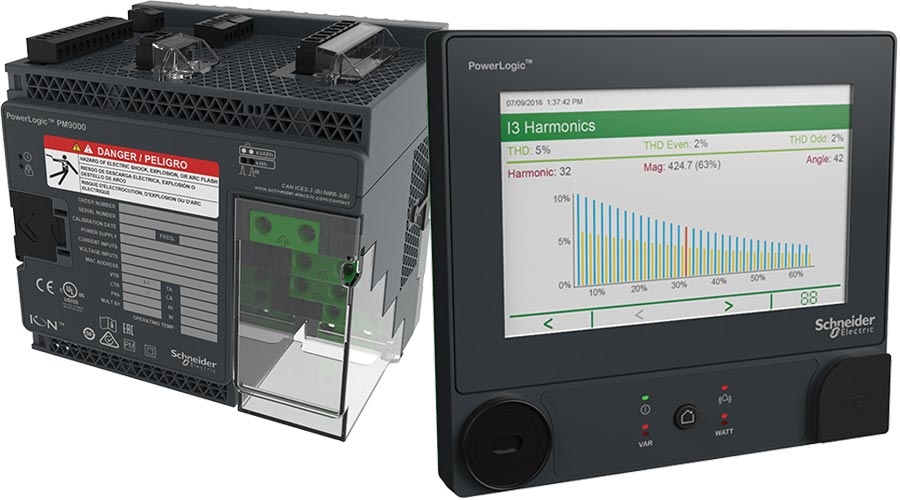
Best for: Mission-critical PQ forensics, high-speed event capture, dispute resolution, R&D labs, data centers, advanced industrial feeders.
Why it stands out:
- Class-A PQ analytics designed for accuracy and repeatability.
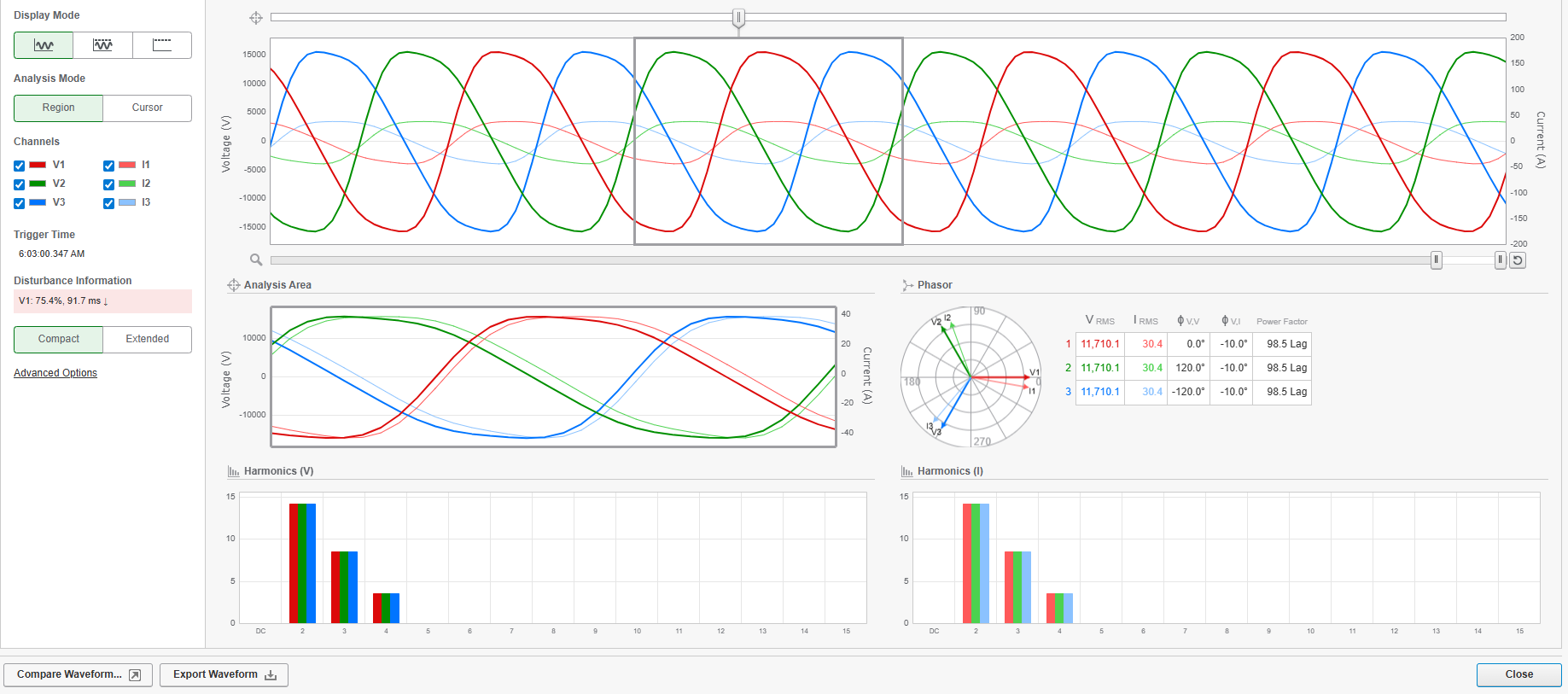
- Deep waveform capture with detailed event records, sag/swell/transient detection, and extensive harmonic and interharmonic analysis.
- Programmable ION framework: Build custom logic, alarms, trending, and sub-metering functions inside the meter.
- Rich comms: Ethernet (Modbus TCP/ION), serial, optional IEC 61850/DNP3 variants depending on configuration.
- High-availability design: Extensive onboard logging, time sync options, and advanced time stamping to correlate multi-feeder events.
- Security-minded: Role-based access, secure protocols (where configured), event logs.
Best use cases: Data centers Tier III/IV, semiconductor, pharma, airports, large hospitals, transmission/distribution feeders, and any site needing court-defensible PQ evidence.
PowerLogic PM8000 Series
Best for: Enterprise rollouts where you want Class-A PQ capabilities with excellent value and standardization across many feeders or MCCs.

Why it stands out:
- Class-A PQ measurements (model/option dependent) with comprehensive sag/swell capture and harmonics.
- Flexible I/O and options suitable for panelboard feeders and MV switchgear.
- Solid waveform/event capture plus max/min logging and trending.
- Excellent ecosystem fit with PME and third-party systems; widely deployed and supported.
- Great price-to-capability ratio for large fleets.
Best use cases: Large manufacturing lines, campus distribution, critical feeder monitoring, energy dashboards with periodic PQ audits.
PowerLogic ION7400
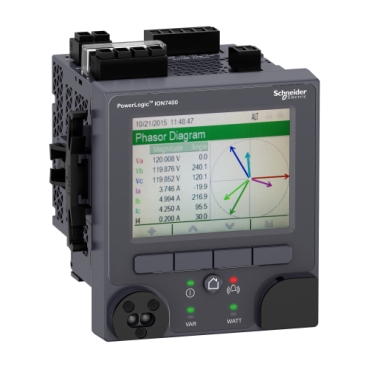
Best for: Feeder-level PQ in utility and industrial substations that need Class-A rigor and ION programmability without going all the way to ION9000.
Why it stands out:
- Feeder-focused Class-A PQ with ION modules for custom logic.
- Designed for substation environments, with utility-friendly features and protocol flexibility.
- Event correlation and waveform capture appropriate for upstream network troubleshooting.
- A sweet spot for teams who want the ION toolkit at a more approachable price point than the ION9000.
Best use cases: MV substations, utility feeders, large plant incomers, and spots where you want deep PQ and utility-grade behavior.
PowerLogic ION8650
Best for: Utility revenue metering with strong PQ visibility on transmission/distribution networks and grid-connected industrials.

Why it stands out:
- Revenue-grade accuracy with utility sealing and time-tested form factor.
- Combines billing-class energy with PQ analytics for settlements and power quality contracts.
- Utility protocols support (model dependent), time sync options, and robust event/sequence-of-events logging.
- Ideal when the same device must satisfy billing and PQ compliance.
Best use cases: Utility metering points, IPPs, large industrial grid connections, embedded generation tie-ins.
PowerLogic PM5000 (PM5560/PM5563) — Budget PQ
Best for: Cost-sensitive projects that still need basic power quality visibility (THD, harmonic snapshots, demand, alarms) and solid energy accuracy.

Why it stands out:
- Excellent energy metering with strong fundamentals and THD/harmonic indicators (model dependent).
- Ideal as a step-up from “kWh-only” meters when you need basic PQ across many feeders.
- Modbus connectivity, simple web pages (on Ethernet models), and straightforward integration to PME or BMS.
- Lower cost → deploy widely to find hotspots before you instrument a few critical points with Class-A analyzers.
Best use cases: Widespread feeder coverage, panels supplying mixed office/retail loads, non-critical MCCs, cost-optimized EMS expansions.
Side-by-Side Comparison Matrix
Note: Capabilities vary by specific model number, options, and firmware. Use this matrix as a selection aid, then confirm with current datasheets.
| Feature / Criterion | ION9000 | PM8000 | ION7400 | ION8650 | PM5560/PM5563 |
|---|---|---|---|---|---|
| Primary Role | Flagship forensic PQ & analytics | Class-A PQ for enterprise rollouts | Substation/feeder Class-A with ION | Utility revenue + PQ | Budget PQ + energy |
| PQ Standard Target | IEC 61000-4-30 Class A (model/firmware dependent) | Class A (series/option dependent) | Class A (series/option dependent) | Class A (series/option dependent) | Basic PQ (THD/harmonics) |
| Waveform/Event Capture Depth | Very high; extensive waveform & transient capture | High; robust events & waveform | High; feeder-focused | High for utility events | Moderate; snapshots/THD |
| Harmonic Analysis | Extensive, incl. interharmonics (where supported) | Full harmonics | Full harmonics | Full harmonics | THD + selected orders |
| Programmability (ION) | Advanced ION framework | Limited/none (not ION-programmable) | ION framework | Utility-oriented; ION lineage | Not ION-programmable |
| Revenue-Grade Energy | High accuracy; revenue optional use cases | High accuracy for energy programs | High accuracy feeder metering | Utility revenue-grade | High accuracy energy (non-utility) |
| Protocols (typical) | Modbus TCP/RTU, ION, options incl. IEC 61850/DNP3 | Modbus TCP/RTU, optional extras by model | Modbus, ION, utility protocols (options) | Utility protocols, time sync | Modbus TCP/RTU |
| On-Device Logging | Very large; forensic | Large; enterprise | Large; feeder | Large; revenue & SOE | Moderate |
| Cybersecurity Features | Role-based access; secure comms options | Role-based access (series dependent) | Role-based access | Utility security workflows | Basic role/password |
| Display/UX | High-resolution display + web server | Graphic display + web | Graphic display | Utility display + SOE | Segment or graphic (model) |
| Typical Locations | Incomers, UPS/PDU, mission-critical feeders | Feeder panels, MCCs, MV switchgear | Substations, utility feeders | Grid tie-ins, revenue points | General panels, broad coverage |
| Price Tier (relative) | $$$$ | $$$ | $$$ | $$$ | $$ |
Application Playbook: Pick the Right Meter for the Job
1) Data Center Incomer / PDU (no surprises allowed)
- Primary pick: ION9000 for deep forensics (transients, interharmonics, correlation).
- Secondary: PM8000 for standardized Class-A PQ across multiple PDUs and UPS outputs.
- Why: Root-cause analysis in minutes, audit-ready PQ reports, and solid integration with DCIM/PME.
2) Semiconductor / Pharma Production Line (sensitive drives, batch yield)
- Primary pick: ION9000 or ION7400 on MV feeders; PM8000 downstream.
- Why: Track sags/swells vs. process events; diagnose harmonic resonance; protect yield.
3) Utility Feeder / Substation (compliance + reliability)
- Primary pick: ION7400 or ION8650 (if revenue is also required).
- Why: Class-A PQ with feeder-grade logic and utility protocols; robust SOE logging.
4) Grid-Connected Industrial (settlement + PQ)
- Primary pick: ION8650 at PCC (Point of Common Coupling) for revenue + PQ; ION7400/PM8000 for internal feeders.
- Why: One meter satisfies billing and PQ clauses; the rest build internal visibility.
5) Multi-Site Commercial Campus (budget control + coverage)
- Primary pick: PM5560/PM5563 widely deployed; PM8000 or ION9000 at incomers.
- Why: Use budget meters to find hotspots, then investigate with a few high-end analyzers.
Integration & Commissioning Tips
Network & Time Sync
- Use NTP or PTP for precise event correlation across devices.
- Keep a dedicated VLAN for metering where possible; segment from corporate IT.
CT/VT Selection
- Match CT class and burden to PQ needs; oversize VA rating where long leads exist.
- For high-fidelity waveform capture, specify shielded twisted pairs for PT runs and short CT leads.
Grounding & EMC
- Follow Schneider’s wiring guides; maintain single-point grounding to minimize measurement noise.
- Keep voltage sense leads away from high-dv/dt conductors.
Logging Strategy
- Configure redundant on-device logging plus PME historian; store at least 90 days of high-resolution data for critical nodes.
- Standardize naming conventions and event thresholds across the fleet.
Dashboards & Alarms
- In PME, build PQ scorecards, EN 50160/IEEE 519 dashboards where applicable, and SLA-tied alarms (e.g., sag severity, flicker).
- Leverage event correlators to cross-reference PQ events with process trips.
Common Mistakes to Avoid
- Using kWh-only meters for PQ questions. You can’t fix what you can’t see.
- Skipping time synchronization. Without synchronized clocks, multi-feeder event correlation gets messy.
- Under-specifying CTs/VTs. Measurement fidelity is only as good as your scaling chain.
- Ignoring cybersecurity. Change defaults, use encrypted options where available, and role-based access.
- Not separating “coverage” from “forensics.” Use budget meters widely; use Class-A analyzers where evidence matters.
FAQs
Q1. Do I always need Class-A?
Not always. Use Class-A where you need evidence for compliance, contracts, or critical troubleshooting. For general awareness, PM5000 class devices might suffice.
Q2. Can I mix meters from different series?
Yes. A common pattern is ION9000/ION7400 at incomers and PM8000/PM5000 downstream. Standardize naming, time sync, and templates.
Q3. What software should I use?
Schneider’s EcoStruxure Power Monitoring Expert (PME) integrates seamlessly and supports advanced PQ analytics and reporting. Many users also expose subsets of data to SCADA/BMS.
Q4. Are these meters revenue-grade?
ION8650 is the utility-class revenue meter; others can deliver very high accuracy but check your utility/regulatory requirements.
Q5. How do I justify cost to management?
Compare meter cost to the risk of downtime, wasted energy from poor PQ, and contract penalties. One avoided outage can repay a PQ program.
Final Verdict
If you’re choosing one flagship analyzer for critical points, pick ION9000. For broad Class-A coverage with excellent ROI, PM8000 is the go-to. For substation/feeder Class-A with ION programmability, ION7400 is a strong match. If you need revenue + PQ at the grid edge, go with ION8650. For budget PQ visibility across dozens of feeders, PM5560/PM5563 delivers tremendous value.
A layered strategy works best:
- Tier 1 (Forensics): ION9000 (and/or ION7400 at feeders)
- Tier 2 (Class-A Coverage): PM8000
- Tier 3 (Wide Coverage / Budget): PM5560/PM5563
- Revenue + PQ at PCC: ION8650